A clear, beginner-friendly guide to the daily Muslim prayer, from getting ready to the closing words. Each step shows what to do, what to say, and what it means, so anyone can follow along.
Which prayer are you learning?
Learn to pray
Learn the whole prayer, one step at a time
Pick a prayer above and the guide expands into every rakʿah of it, in order. Each step shows you exactly what to do and exactly what to say, with the Arabic, how to pronounce it, and what it means.
18 guided steps for Fajr (2 rakʿāt)
Arabic · pronunciation · meaning
About five minutes to learn
This is a simple, general guide to the daily prayer as commonly taught in the Sunni tradition. Small details differ between the schools of thought. For anything you are unsure about, learn directly from a knowledgeable local teacher.
Get ready
01
Get ready · 1 of 3
Purify yourself with wudūʾ
Do this
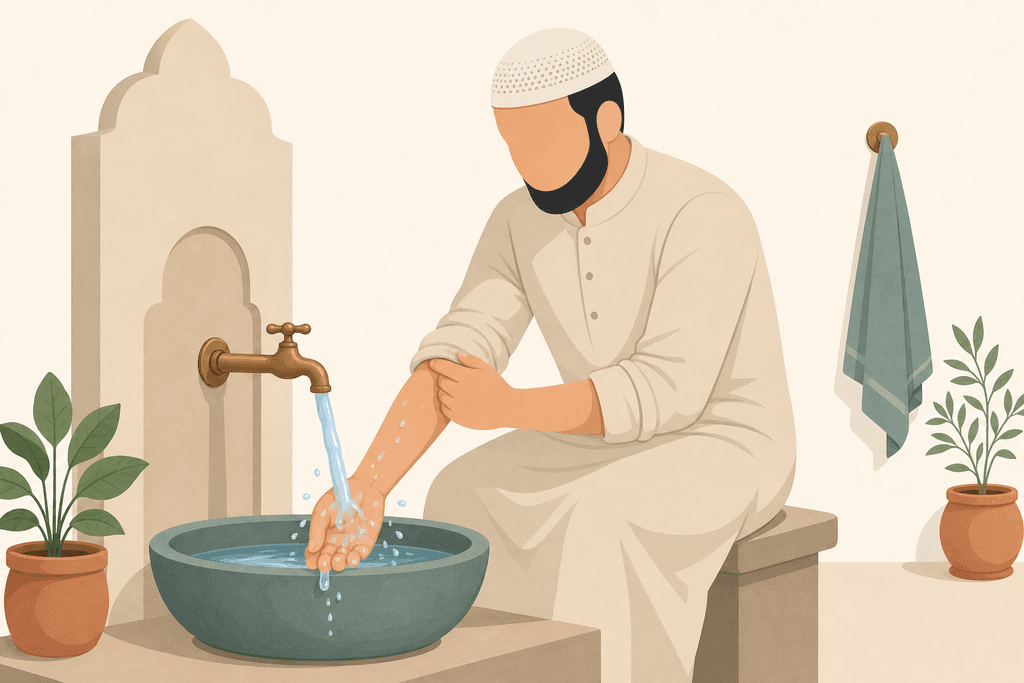
Before praying, perform wudūʾ (ablution): wash your hands, rinse your mouth and nose, wash your face, wash your arms to the elbows, wipe your head, and wash your feet to the ankles. If you are already in a state of purity, you may pray straight away.
Get it right
Begin with the intention in your heart and say “Bismillāh”.
Wash both hands up to the wrists three times, starting with the right.
Rinse the mouth three times, then sniff water into the nose and blow it out, three times.
Wash the whole face three times: from the hairline to under the chin, and from ear to ear.
Wash the right arm from the fingertips to just past the elbow three times, then the left arm.
Wipe the head once with wet hands, from the front to the back and forward again, then wipe the ears inside and out.
Wash the right foot up to and including the ankle three times, then the left, cleaning between the toes.
Get ready
02
Get ready · 2 of 3
Dress modestly and find a clean spot
Do this
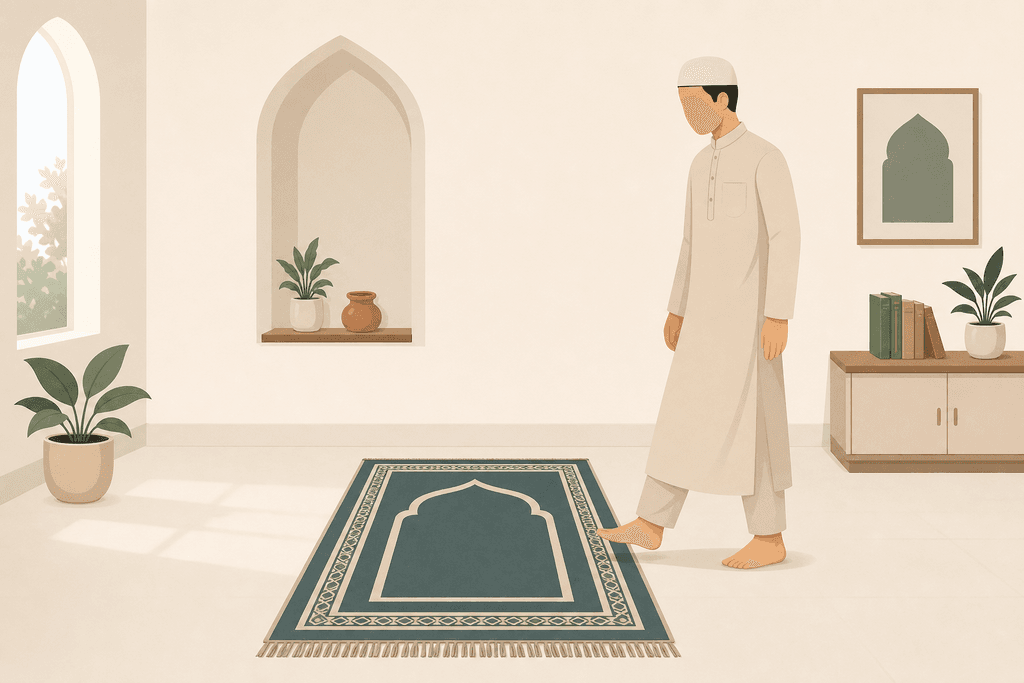
Cover your body appropriately and choose a clean, quiet place to pray. A prayer mat is helpful but not required, any clean surface will do.
Get it right
Men must cover at least from the navel to the knees, and should also cover the shoulders.
Women cover everything except the face and hands, in loose clothing that does not show the shape of the body.
Your body, your clothes, and the spot you pray on must be clean and free of impurity.
Choose a place where nobody will walk directly in front of you and where you will not be interrupted.
Get ready
03
Get ready · 3 of 3
Face the Qibla
Do this
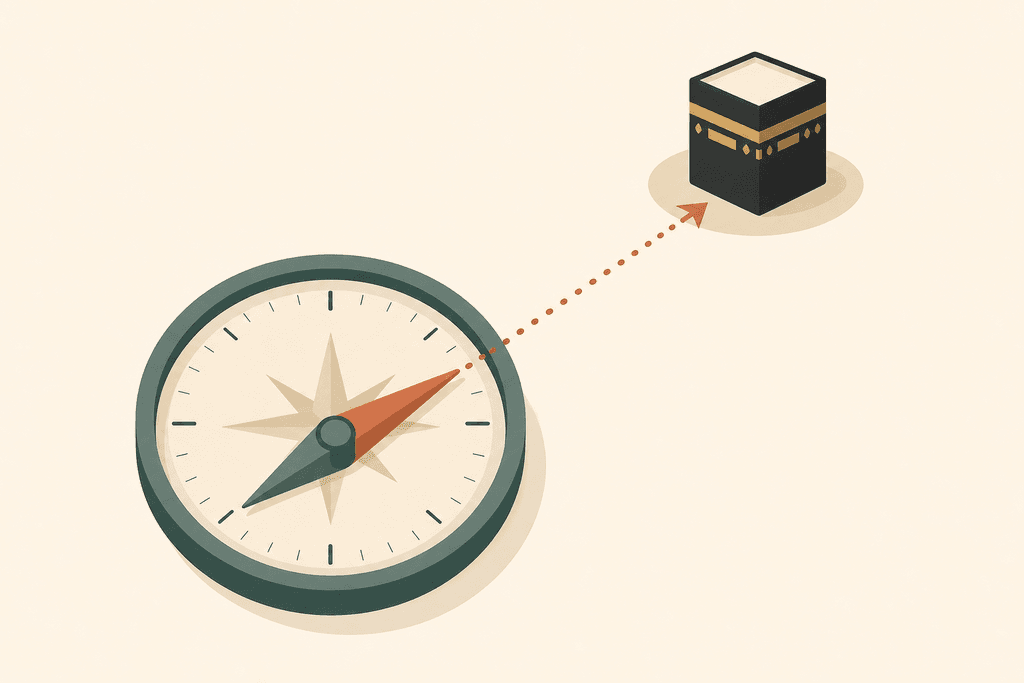
Turn to face the Qibla, the direction of the Kaʿbah in Mecca. If you are unsure, use a compass or a Qibla app to find it.
Get it right
Face the Kaʿbah in Mecca. A Qibla app, a compass, or the marked wall of a mosque will show you the direction.
Point your face, chest, and feet all the same way, with the feet about shoulder-width apart.
If you truly cannot work out the direction, face your best estimate; the prayer is still valid.
Begin
01
Step 1 of 18
Begin with the opening takbīr
Do this
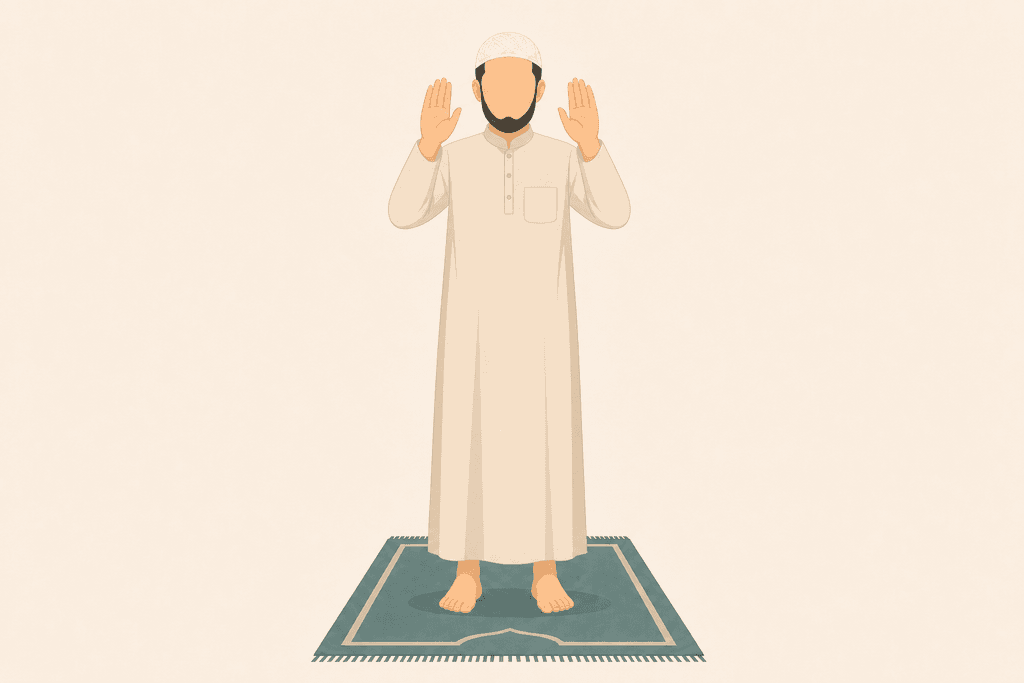
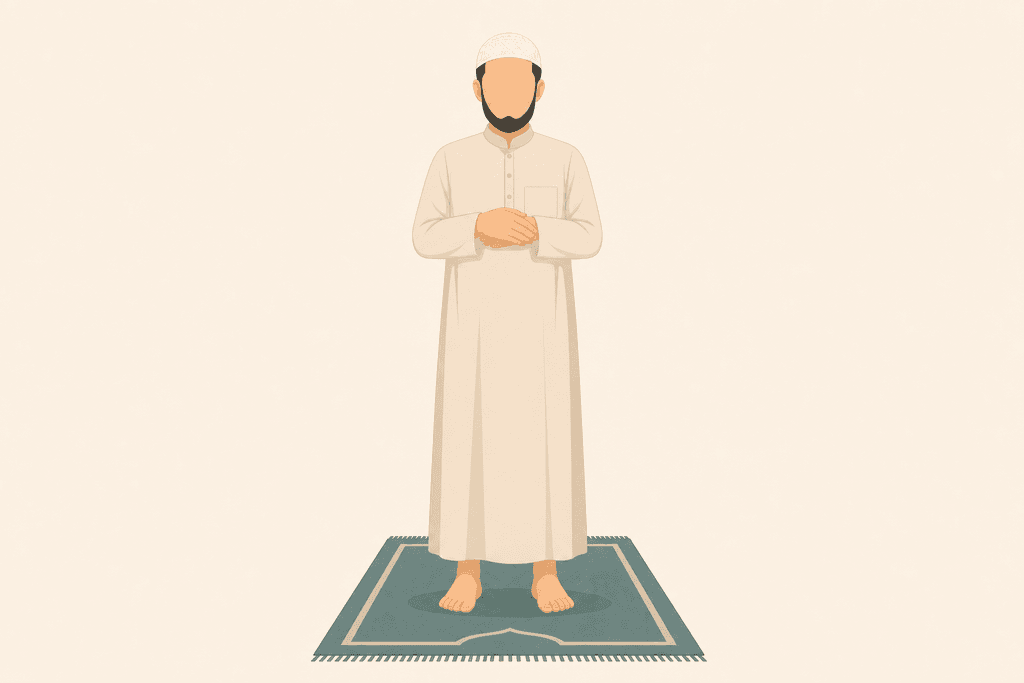
Stand upright and face the Qibla. Make the intention in your heart for the prayer you are about to perform. This is silent, not spoken aloud. Raise your hands to your ears or shoulders and say the opening takbīr. Then rest your right hand over your left on your chest.
Say this
اللَّهُ أَكْبَرُ
How to say it
Allāhu akbar
Meaning
“Allah is the Greatest.”
Get it right
Make the intention silently in your heart: you are about to pray Fajr. Nothing is said aloud.
Raise both hands to shoulder or earlobe level, palms facing the Qibla, fingers together and relaxed.
Say “Allāhu akbar” as your hands reach the top, then lower them.
Place the right hand over the left, resting on the chest. Some schools place them below the navel; either is fine.
Look at the spot where your forehead will touch the ground, and do not look around during the prayer.
Begin
02
Step 2 of 18
Open with words of praise (Istiftāḥ)
Do this
Before you begin reciting, praise Allah quietly with the opening supplication (duʿāʾ al-istiftāḥ). This is said once, at the very start of the prayer:
Subḥānaka-llāhumma wa biḥamdik, wa tabāraka-smuk, wa taʿālā jadduk, wa lā ilāha ghayruk
Meaning
“Glory be to You, O Allah, and praise be to You. Blessed is Your name, and exalted is Your majesty. There is no god but You.”
Get it right
Stay standing exactly as you were: right hand over left, eyes on the place of prostration.
Say these words quietly, so that only you can hear them.
It is said once per prayer, not in every rakʿah, and the prayer is still valid if you forget it.
Rakʿah 1
03
Step 3 of 18
Recite while standing (Qiyām)
Rakʿah 1 of 2
Do this
Standing with your hands folded, first seek refuge in Allah with the words below. Then say the Basmalah and recite Surah Al-Fātiḥah, the opening chapter of the Quran.
In this rakʿah: Al-Fātiḥah, then a short surah (shown below)Recited aloud
Say this
أَعُوذُ بِاللَّهِ مِنَ الشَّيْطَانِ الرَّجِيمِ
How to say it
Aʿūdhu billāhi mina-sh-shayṭāni-r-rajīm
Meaning
“I seek refuge in Allah from Satan, the accursed.”
Recite Al-Fātiḥah in full, verse by verse, and say “Āmīn” when it ends:
بِسْمِ ٱللَّهِ ٱلرَّحْمَٰنِ ٱلرَّحِيمِ﴿1﴾
Bismillaahir Rahmaanir Raheem
In the name of Allah, the Entirely Merciful, the Especially Merciful.
ٱلْحَمْدُ لِلَّهِ رَبِّ ٱلْعَٰلَمِينَ﴿2﴾
Alhamdu lillaahi Rabbil 'aalameen
[All] praise is [due] to Allah, Lord of the worlds -
Keep the right hand over the left on the chest and your gaze on the place of prostration.
Say the words of refuge below quietly, then the Basmalah: “Bismillāhi-r-Raḥmāni-r-Raḥīm”.
Recite Al-Fātiḥah slowly, verse by verse. It is required in every rakʿah.
Say “Āmīn” when Al-Fātiḥah ends.
After “Āmīn”, recite the short surah shown below, then bow.
In this rakʿah, recite aloud, clearly enough to hear yourself.
Rakʿah 1
04
Step 4 of 18
Bow down (Rukūʿ)
Rakʿah 1 of 2
As you move into this position, sayاللَّهُ أَكْبَرُ
Do this
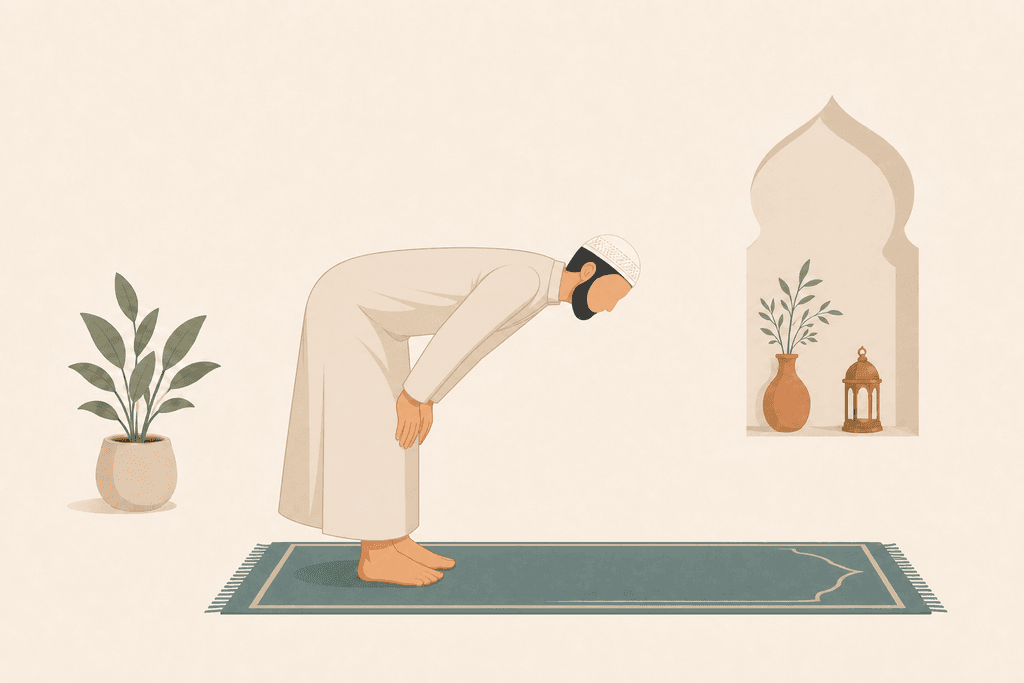
Say “Allāhu akbar” and bow forward, resting your hands on your knees with your back level and your eyes toward the place of prostration. While bowing, repeat these words three times:
Say thisRepeat 3 times
سُبْحَانَ رَبِّيَ الْعَظِيمِ
How to say it
Subḥāna Rabbiya-l-ʿAẓīm
Meaning
“Glory to my Lord, the Most Great.”
Get it right
Say “Allāhu akbar” as you begin to bend. Raising the hands as in the opening takbīr is practised in most schools.
Grip your knees with your hands, fingers spread apart, arms straight and elbows away from your sides.
Make your back flat and level, with your head in line with it: neither raised nor drooping.
Look at the place of prostration and be completely still before you begin the words.
Say “Subḥāna Rabbiya-l-ʿAẓīm” three times.
Rakʿah 1
05
Step 5 of 18
Rise and stand up straight (Iʿtidāl)
Rakʿah 1 of 2
Do this
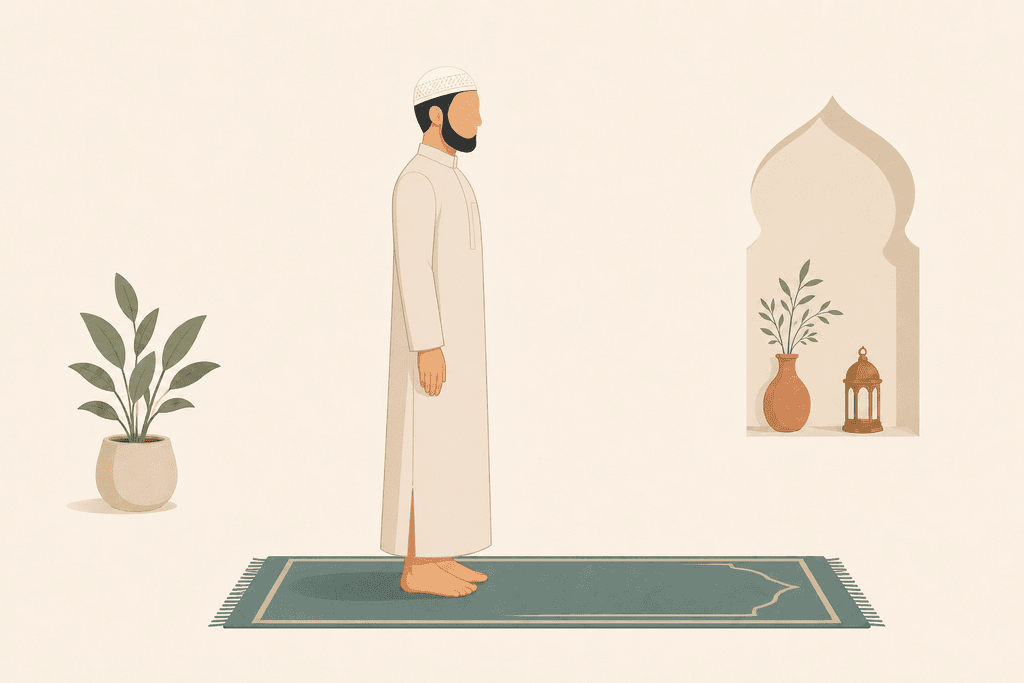
Rise from bowing until you are standing straight and completely still. As you rise, say the first phrase; once upright, say the second:
Samiʿa-llāhu liman ḥamidah, Rabbanā wa laka-l-ḥamd
Meaning
“Allah hears whoever praises Him. Our Lord, to You belongs all praise.”
Get it right
Say “Samiʿa-llāhu liman ḥamidah” while rising, raising your hands to shoulder level if you did so for rukūʿ.
Stand fully upright with your arms at your sides (folded on the chest is also practised), every joint settled.
Once you are still, say “Rabbanā wa laka-l-ḥamd”.
Do not rush this pause. Standing calmly here is part of the prayer.
Rakʿah 1
06
Step 6 of 18
Prostrate (Sujūd)
Rakʿah 1 of 2
As you move into this position, sayاللَّهُ أَكْبَرُ
Do this
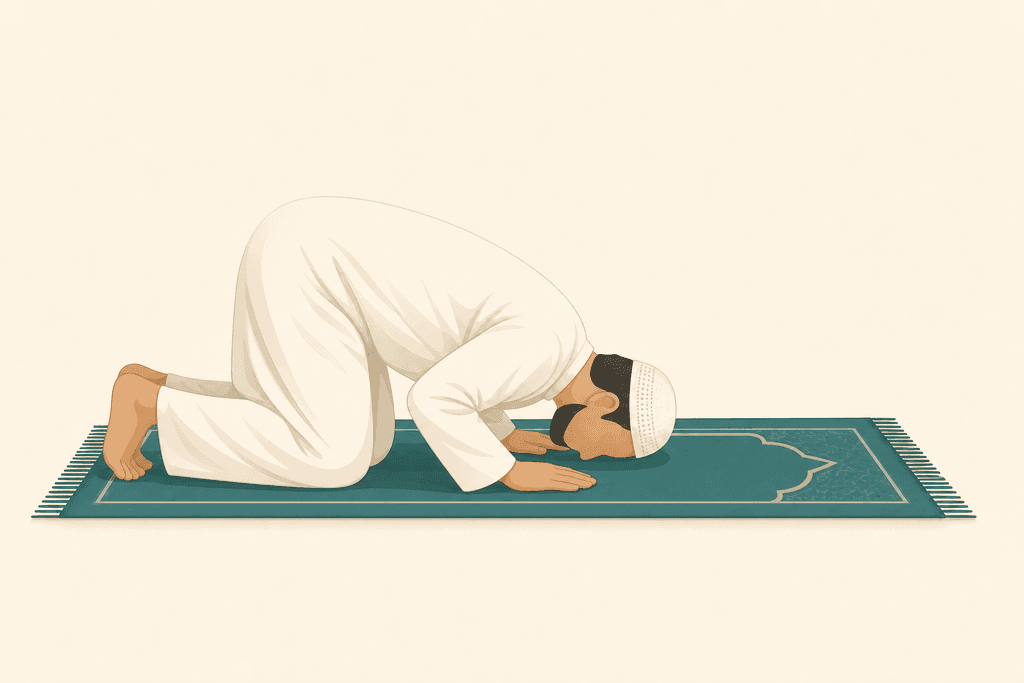
Say “Allāhu akbar” and lower yourself into prostration so that seven parts touch the ground: your forehead and nose, both palms, both knees, and the toes of both feet. While prostrating, repeat these words three times:
Say thisRepeat 3 times
سُبْحَانَ رَبِّيَ الْأَعْلَىٰ
How to say it
Subḥāna Rabbiya-l-Aʿlā
Meaning
“Glory to my Lord, the Most High.”
Get it right
Say “Allāhu akbar” as you go down. Knees first or hands first: both are practised.
Seven points touch the ground: the forehead and nose together, both palms, both knees, and the toes of both feet.
Place the palms flat, level with the shoulders or ears, fingers together and pointing to the Qibla.
Lift the elbows and forearms off the ground. Only the palms rest on it.
Keep the feet upright with the heels together and the toes bent, pointing to the Qibla.
Keep the belly off the thighs and the thighs off the calves, so the body is not bunched up.
Say “Subḥāna Rabbiya-l-Aʿlā” three times.
Rakʿah 1
07
Step 7 of 18
Sit briefly between prostrations (Jalsa)
Rakʿah 1 of 2
As you move into this position, sayاللَّهُ أَكْبَرُ
Do this
Say “Allāhu akbar,” rise from prostration, and sit calmly and upright for a moment, saying:
Say this
رَبِّ اغْفِرْ لِي
How to say it
Rabbi-ghfir lī
Meaning
“My Lord, forgive me.”
Get it right
Say “Allāhu akbar” as you rise from prostration into sitting.
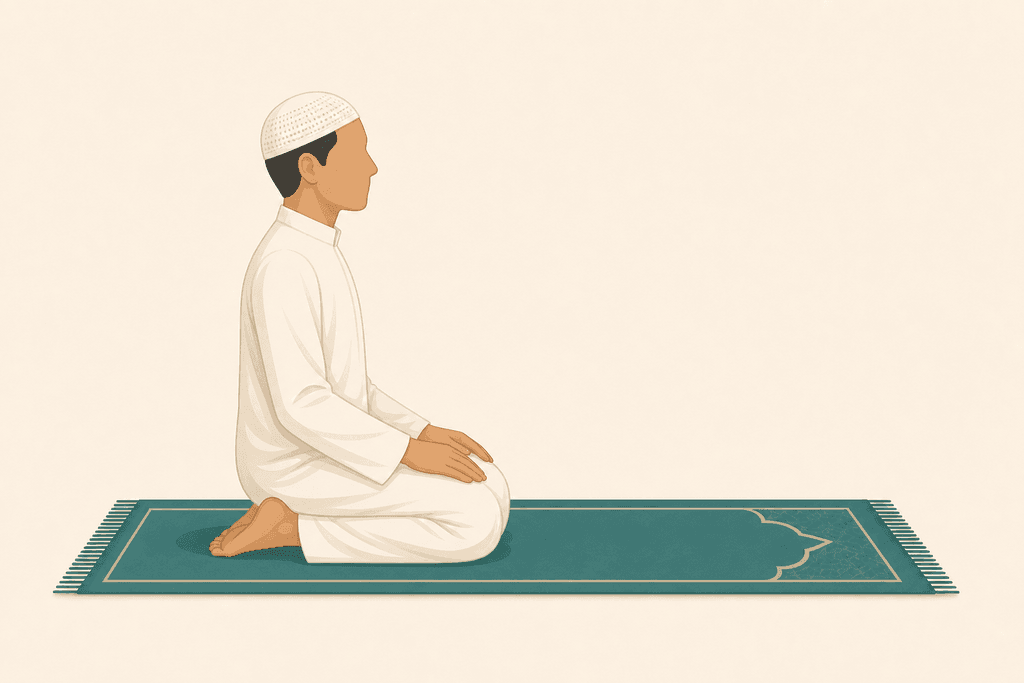
Lay the left foot flat and sit on it. Keep the right foot upright with its toes pointing to the Qibla.
Rest your hands on your thighs near the knees, fingers together and pointing to the Qibla.
Sit completely still and say “Rabbi-ghfir lī”. Once is enough; two or three times is also good.
Rakʿah 1
08
Step 8 of 18
Prostrate again and complete the unit
Rakʿah 1 of 2
As you move into this position, sayاللَّهُ أَكْبَرُ
Do this
Say “Allāhu akbar” and prostrate a second time, exactly as you did before, repeating the same words of glorification. When you rise from it, this rakʿah is complete.
Say thisRepeat 3 times
سُبْحَانَ رَبِّيَ الْأَعْلَىٰ
How to say it
Subḥāna Rabbiya-l-Aʿlā
Meaning
“Glory to my Lord, the Most High.”
Get it right
Say “Allāhu akbar” and go down again into exactly the same posture: seven points on the ground, elbows raised.
Say “Subḥāna Rabbiya-l-Aʿlā” three times.
Then
Say “Allāhu akbar” and stand straight up to begin rakʿah 2. A brief sit before standing is also practised.
Rakʿah 2
09
Step 9 of 18
Recite while standing (Qiyām)
Rakʿah 2 of 2
Do this
Standing with your hands folded, first seek refuge in Allah with the words below. Then say the Basmalah and recite Surah Al-Fātiḥah, the opening chapter of the Quran.
In this rakʿah: Al-Fātiḥah, then a short surah (shown below)Recited aloud
Say this
أَعُوذُ بِاللَّهِ مِنَ الشَّيْطَانِ الرَّجِيمِ
How to say it
Aʿūdhu billāhi mina-sh-shayṭāni-r-rajīm
Meaning
“I seek refuge in Allah from Satan, the accursed.”
Recite Al-Fātiḥah in full, verse by verse, and say “Āmīn” when it ends:
بِسْمِ ٱللَّهِ ٱلرَّحْمَٰنِ ٱلرَّحِيمِ﴿1﴾
Bismillaahir Rahmaanir Raheem
In the name of Allah, the Entirely Merciful, the Especially Merciful.
ٱلْحَمْدُ لِلَّهِ رَبِّ ٱلْعَٰلَمِينَ﴿2﴾
Alhamdu lillaahi Rabbil 'aalameen
[All] praise is [due] to Allah, Lord of the worlds -
Keep the right hand over the left on the chest and your gaze on the place of prostration.
Say the words of refuge below quietly, then the Basmalah: “Bismillāhi-r-Raḥmāni-r-Raḥīm”.
Recite Al-Fātiḥah slowly, verse by verse. It is required in every rakʿah.
Say “Āmīn” when Al-Fātiḥah ends.
After “Āmīn”, recite the short surah shown below, then bow.
In this rakʿah, recite aloud, clearly enough to hear yourself.
Rakʿah 2
10
Step 10 of 18
Bow down (Rukūʿ)
Rakʿah 2 of 2
As you move into this position, sayاللَّهُ أَكْبَرُ
Do this
Say “Allāhu akbar” and bow forward, resting your hands on your knees with your back level and your eyes toward the place of prostration. While bowing, repeat these words three times:
Say thisRepeat 3 times
سُبْحَانَ رَبِّيَ الْعَظِيمِ
How to say it
Subḥāna Rabbiya-l-ʿAẓīm
Meaning
“Glory to my Lord, the Most Great.”
Get it right
Say “Allāhu akbar” as you begin to bend. Raising the hands as in the opening takbīr is practised in most schools.
Grip your knees with your hands, fingers spread apart, arms straight and elbows away from your sides.
Make your back flat and level, with your head in line with it: neither raised nor drooping.
Look at the place of prostration and be completely still before you begin the words.
Say “Subḥāna Rabbiya-l-ʿAẓīm” three times.
Rakʿah 2
11
Step 11 of 18
Rise and stand up straight (Iʿtidāl)
Rakʿah 2 of 2
Do this
Rise from bowing until you are standing straight and completely still. As you rise, say the first phrase; once upright, say the second:
Samiʿa-llāhu liman ḥamidah, Rabbanā wa laka-l-ḥamd
Meaning
“Allah hears whoever praises Him. Our Lord, to You belongs all praise.”
Get it right
Say “Samiʿa-llāhu liman ḥamidah” while rising, raising your hands to shoulder level if you did so for rukūʿ.
Stand fully upright with your arms at your sides (folded on the chest is also practised), every joint settled.
Once you are still, say “Rabbanā wa laka-l-ḥamd”.
Do not rush this pause. Standing calmly here is part of the prayer.
Rakʿah 2
12
Step 12 of 18
Prostrate (Sujūd)
Rakʿah 2 of 2
As you move into this position, sayاللَّهُ أَكْبَرُ
Do this
Say “Allāhu akbar” and lower yourself into prostration so that seven parts touch the ground: your forehead and nose, both palms, both knees, and the toes of both feet. While prostrating, repeat these words three times:
Say thisRepeat 3 times
سُبْحَانَ رَبِّيَ الْأَعْلَىٰ
How to say it
Subḥāna Rabbiya-l-Aʿlā
Meaning
“Glory to my Lord, the Most High.”
Get it right
Say “Allāhu akbar” as you go down. Knees first or hands first: both are practised.
Seven points touch the ground: the forehead and nose together, both palms, both knees, and the toes of both feet.
Place the palms flat, level with the shoulders or ears, fingers together and pointing to the Qibla.
Lift the elbows and forearms off the ground. Only the palms rest on it.
Keep the feet upright with the heels together and the toes bent, pointing to the Qibla.
Keep the belly off the thighs and the thighs off the calves, so the body is not bunched up.
Say “Subḥāna Rabbiya-l-Aʿlā” three times.
Rakʿah 2
13
Step 13 of 18
Sit briefly between prostrations (Jalsa)
Rakʿah 2 of 2
As you move into this position, sayاللَّهُ أَكْبَرُ
Do this
Say “Allāhu akbar,” rise from prostration, and sit calmly and upright for a moment, saying:
Say this
رَبِّ اغْفِرْ لِي
How to say it
Rabbi-ghfir lī
Meaning
“My Lord, forgive me.”
Get it right
Say “Allāhu akbar” as you rise from prostration into sitting.
Lay the left foot flat and sit on it. Keep the right foot upright with its toes pointing to the Qibla.
Rest your hands on your thighs near the knees, fingers together and pointing to the Qibla.
Sit completely still and say “Rabbi-ghfir lī”. Once is enough; two or three times is also good.
Rakʿah 2
14
Step 14 of 18
Prostrate again and complete the unit
Rakʿah 2 of 2
As you move into this position, sayاللَّهُ أَكْبَرُ
Do this
Say “Allāhu akbar” and prostrate a second time, exactly as you did before, repeating the same words of glorification. When you rise from it, this rakʿah is complete.
Say thisRepeat 3 times
سُبْحَانَ رَبِّيَ الْأَعْلَىٰ
How to say it
Subḥāna Rabbiya-l-Aʿlā
Meaning
“Glory to my Lord, the Most High.”
Get it right
Say “Allāhu akbar” and go down again into exactly the same posture: seven points on the ground, elbows raised.
Say “Subḥāna Rabbiya-l-Aʿlā” three times.
Then
This was the last rakʿah. Rise saying “Allāhu akbar” into a sitting position and stay seated: the prayer now closes with the Tashahhud.
Closing
15
Step 15 of 18
Sit for the Tashahhud
Do this
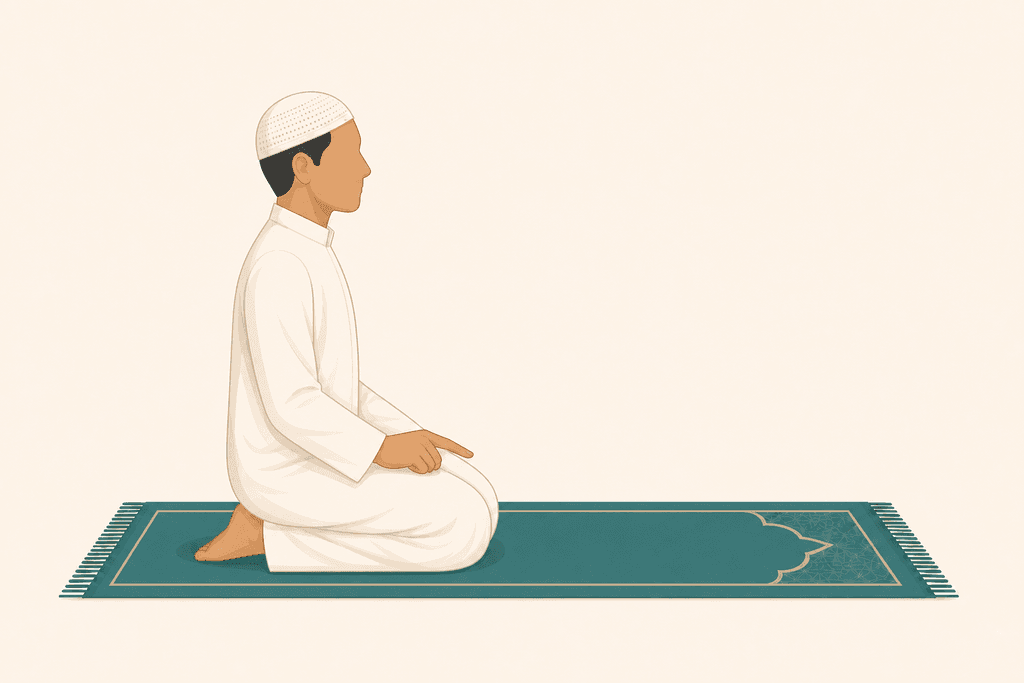
Sitting after the second prostration, recite the Tashahhud, the testimony of faith. When you reach the words “illa-llāh,” it is customary to raise your right index finger.
At-taḥiyyātu lillāhi wa-ṣ-ṣalawātu wa-ṭ-ṭayyibāt. As-salāmu ʿalayka ayyuha-n-nabiyyu wa raḥmatu-llāhi wa barakātuh. As-salāmu ʿalaynā wa ʿalā ʿibādi-llāhi-ṣ-ṣāliḥīn. Ashhadu an lā ilāha illa-llāh, wa ashhadu anna Muḥammadan ʿabduhu wa rasūluh.
Meaning
“All greetings, prayers, and good things are for Allah. Peace be upon you, O Prophet, and the mercy of Allah and His blessings. Peace be upon us and upon the righteous servants of Allah. I bear witness that there is no god but Allah, and I bear witness that Muhammad is His servant and messenger.”
Get it right
Sit as in the pause between prostrations: left foot flat beneath you, right foot upright, toes towards the Qibla.
In the final sitting, many scholars prefer tawarruk: slide the left foot out under the right shin and sit on the ground, right foot still upright. Sitting as before is also valid.
Rest the left hand on the left thigh. Close the right hand into a loose fist on the right thigh.
Raise the right index finger when you say “illa-llāh” (some keep it raised throughout), and look at the finger.
Recite the whole Tashahhud slowly. It is required in every sitting.
Then
This is the final sitting, so stay seated after the Tashahhud: the blessings on the Prophet ﷺ come next.
Closing
16
Step 16 of 18
Send blessings on the Prophet ﷺ
Do this
Still seated, send blessings upon the Prophet Muhammad ﷺ. This prayer is known as the Ṣalāt Ibrāhīmiyyah:
Allāhumma ṣalli ʿalā Muḥammad wa ʿalā āli Muḥammad, kamā ṣallayta ʿalā Ibrāhīm wa ʿalā āli Ibrāhīm, innaka Ḥamīdun Majīd.
Meaning
“O Allah, send blessings upon Muhammad and the family of Muhammad, as You sent blessings upon Ibrahim and the family of Ibrahim; indeed, You are Praiseworthy and Glorious.”
Get it right
Stay in the same sitting posture, with the index finger raised or the hands resting on the thighs.
Recite quietly and without hurry. In the final sitting this is required, not optional.
Closing
17
Step 17 of 18
Make a closing supplication (Duʿāʾ)
Do this
Before the closing greeting, it is recommended to seek refuge in Allah and then to make personal supplication (duʿāʾ) for whatever you wish, in any language. A supplication the Prophet ﷺ taught for this moment is:
Allāhumma innī aʿūdhu bika min ʿadhābi-l-qabr, wa min ʿadhābi jahannam, wa min fitnati-l-maḥyā wa-l-mamāt, wa min sharri fitnati-l-masīḥi-d-dajjāl
Meaning
“O Allah, I seek refuge in You from the punishment of the grave, from the punishment of Hell, from the trials of life and death, and from the evil of the trial of the False Messiah (the Dajjāl).”
Get it right
Keep the same seated posture. Nothing changes in the hands or feet.
Begin with the words of refuge below, then ask Allah for whatever you need, in any language.
Keep it brief for now. The prayer is not complete until the greeting of peace.
Closing
18
Step 18 of 18
End with the greeting of peace (Taslīm)
Do this
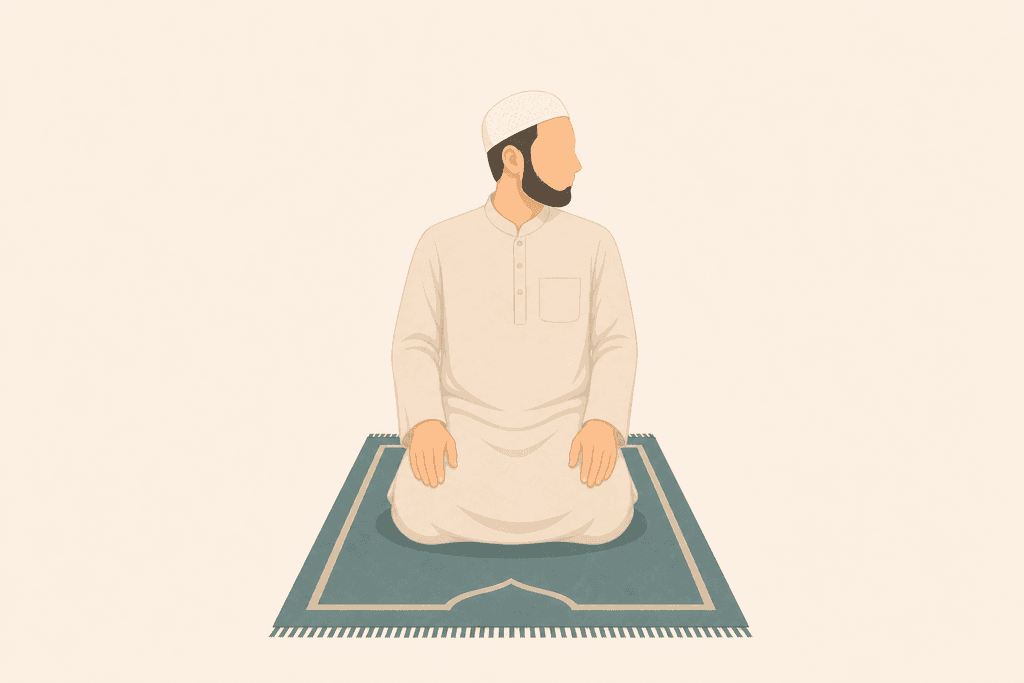
To end the prayer, turn your face to the right and say the words of peace, then turn to the left and repeat them. This greeting closes your prayer.
Say this
السَّلَامُ عَلَيْكُمْ وَرَحْمَةُ اللَّهِ
How to say it
As-salāmu ʿalaykum wa raḥmatu-llāh
Meaning
“Peace and the mercy of Allah be upon you.”
Get it right
Turn your head fully to the right, until your cheek could be seen from behind, and say the words.
Then turn fully to the left and say them again.
Your hands stay on your thighs and your body stays facing the Qibla. Only the head turns.
The prayer has now ended. It is good to stay seated a moment for remembrance (dhikr) and personal duʿāʾ.
Closing
That is the whole Fajr prayer
You have walked through all 2 rakʿāt of Fajr: every position and every word. Pick another prayer above to see how it differs, and use these counts for the rest of the day.
Each of the five daily prayers has a set number of obligatory units (rakaʿāt). Here is how many to perform in each.
FajrDawn
2rakat
DhuhrMidday
4rakat
AsrAfternoon
4rakat
MaghribSunset
3rakat
IshaNight
4rakat
Frequently asked questions
Common questions about Muslim prayer, from prayer times and wudūʾ to praying while traveling, sick, or still learning the Arabic words.
How many times a day do Muslims pray?
Muslims perform five obligatory prayers each day: Fajr (dawn), Dhuhr (midday), Asr (afternoon), Maghrib (sunset), and Isha (night). Each has a set time window and a fixed number of units (rakʿāt), and together they form one of the five pillars of Islam.
What time are the five daily prayers?
Prayer times follow the sun: Fajr from true dawn until sunrise, Dhuhr after the sun passes its peak, Asr in the late afternoon, Maghrib just after sunset, and Isha after twilight disappears. Exact clock times change daily by location, so use a local timetable or prayer-times app.
Can I pray salah in English if I don't know Arabic?
The core recitations of salah, especially Surah Al-Fātiḥah, are performed in Arabic. While you are learning, use transliteration and study the meanings, and recite what you can to the best of your ability. Personal duʿāʾ outside the formal recitations may be made in any language.
What breaks wudu?
Wudūʾ is broken by using the toilet, passing wind, deep sleep, and loss of consciousness (some details vary between schools). Ordinary activities like eating, talking, or walking do not break it. You only renew wudūʾ when something invalidates it.
Do I need to do wudu before every prayer?
No. One wudūʾ stays valid until something breaks it, so you can pray several prayers with the same wudūʾ. You only repeat it if it has been invalidated.
What should I do if I miss a prayer?
If you miss an obligatory prayer unintentionally, pray it as soon as you remember or are able. This make-up prayer (qaḍāʾ) is performed exactly like the original, with the same number of rakʿāt. If several are owed, pray them in order when possible. Deliberately delaying prayer without excuse is a serious matter in Islam, so building a consistent daily routine helps.
Can women pray during their period?
No, women do not perform the five daily salah during menstruation or postnatal bleeding. They are not required to make those prayers up afterward. Prayer resumes once the bleeding ends and ghusl (a full bath) has been performed.
Do women pray differently from men?
The words, movements, and number of rakʿāt are the same for women and men. The main practical difference is dress, a woman covers everything except the face and hands, and some schools recommend slightly more compact postures. Follow the method taught by your school or a trusted local teacher.
Can I pray sitting down or in a chair?
Yes. If standing causes hardship due to illness, injury, or age, pray sitting; if that is not possible, pray lying down, indicating the bow and prostration with head movements. Islam only requires what you are physically able to do, and the reward is not reduced when there is a genuine need.
What is the difference between fard, sunnah, and nafl rakʿāt?
Farḍ rakʿāt are the obligatory units required for the prayer to count, the counts shown in the table above (2 for Fajr, 4 for Dhuhr, and so on). Sunnah rakʿāt are extra units the Prophet ﷺ regularly prayed alongside them, and nafl are additional voluntary prayers. Beginners should focus on learning the farḍ prayer correctly first, then add sunnah units as they grow comfortable.
How do I pray when traveling?
On a qualifying journey, the four-unit prayers (Dhuhr, Asr, and Isha) may be shortened to two units (qaṣr). Many scholars also allow combining Dhuhr with Asr, and Maghrib with Isha, within the allowed windows. Fajr and Maghrib keep their usual length. Confirm the distance and combining rules with your school or a local teacher.
What do I do if I make a mistake during salah?
Minor slips do not invalidate the prayer. Correct them and continue. If you forget a step or lose count of rakʿāt, complete the prayer and perform two extra prostrations (sujūd as-sahw) to make up for the error. Allah is merciful, and honest mistakes do not invalidate your effort while you are learning.
What if I prayed facing the wrong direction?
If you made a sincere effort to find the Qibla using a compass or app but later learned you were off, your prayer is generally still valid. If you realize the mistake during the prayer, turn to face the correct direction and continue. Use a reliable Qibla tool next time to reduce uncertainty.
Do I need a prayer mat to pray?
No. Any clean surface is enough: a floor, carpet, grass, or outdoors. A prayer mat is simply a convenient way to ensure the area you are praying on is clean and comfortable, but it is not required.
Can you pray with nail polish on?
Standard nail polish forms a waterproof barrier, so it must be removed before wudūʾ for the wudūʾ to be valid, since water must reach the nails. Applying polish after a valid wudūʾ does not break that wudūʾ, so you may pray until the wudūʾ is invalidated. Water-permeable halal nail polishes exist as an alternative for those who prefer them.
How long does it take to pray?
A single obligatory prayer usually takes about five to ten minutes once you know the steps. Fajr is the shortest, while the four-unit prayers take a little longer. Beginners reading transliteration may take a bit more time. Adding optional sunnah units or longer Quranic passages extends the time.
Do I have to memorize everything before I can start praying?
No, you can begin learning salah while still memorizing the essential recitations. Start with "Allāhu akbar" and Surah Al-Fātiḥah, then add the basic phrases for bowing, prostration, and sitting. Reading from transliteration on a card or phone is widely used while you build memory. It is better to pray imperfectly and improve than to wait until everything is memorized.
How do I make the intention (niyyah) for prayer?
The intention is made silently in your heart before you say the opening takbīr. You simply know which prayer you are about to perform (for example, the farḍ of ʿIshāʾ). It is not spoken aloud and does not need a specific formula in Arabic. A clear, sincere intention in your mind is sufficient.
Is Friday prayer (Jumuʿah) different from Dhuhr?
Yes. On Fridays, Muslim men who are able to attend replace the Dhuhr prayer with Jumuʿah, which includes a sermon (khuṭbah) and a congregational prayer, usually two rakʿāt. Women, travelers, and those unable to attend may pray Dhuhr as normal at home. Jumuʿah is a weekly community obligation for eligible men, not a separate fifth daily prayer.
What is tayammum and when do I use it?
Tayammum is dry purification performed by striking clean earth (or dust) and wiping the face and hands when water is unavailable, unsafe to use, or would cause harm. It takes the place of wudūʾ (or ghusl) for that prayer time. Once water becomes available again, normal wudūʾ should be performed for subsequent prayers.
Which prayers are recited aloud and which silently?
In congregation, the imam recites aloud in Fajr and in the first two units of Maghrib and Isha; Dhuhr and Asr are recited quietly. When praying alone, the same pattern is commonly followed, though schools differ on how strictly a person praying alone must raise their voice.
How do I pray at work or school?
You can pray in any clean, quiet space at work or school: an empty office, an interfaith room, or a quiet corner. A single prayer usually takes only five to ten minutes. Many employers and schools will accommodate a brief prayer break if you ask.